Rotary Dryer Selection Guide
When you consider that a typical heavy-duty rotary dryer lasts decades, the importance of picking a reliable, application-matched dryer becomes …
March 27, 2026
READ MORE


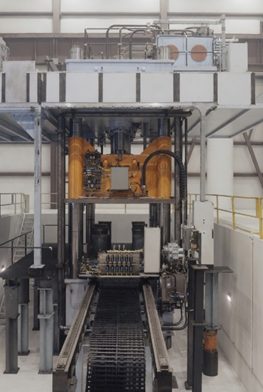
Few tools have shaped industrial manufacturing as much as the hydraulic press - a technology with more than a century of proven performance. Today’s “smart hydraulic presses” have incorporated automation integration with on-board intelligence. Manufacturers who understand and unitize these technologies will be better positioned to capitalize on them.
Press tending automation, connected sensors, and data-driven process control is reshaping what a hydraulic press can do and more importantly, how it is performing.
Williams, White & Companies perspective on how we see that evolution unfolding, and what it means for manufacturers specifying equipment today.
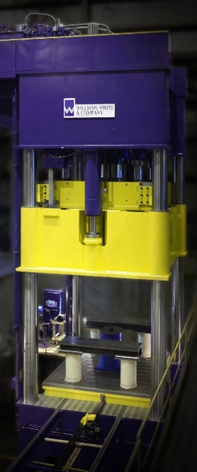
For most of their history, hydraulic presses have been simple force-delivery machines. You set a few parameters like pressure, stroke, speed, and the press executes. Feedback was limited. Process visibility was limited. If something went wrong, you often found out through a bad part or a maintenance event rather than a control system alert.
Modern press systems increasingly incorporate real-time pressure transducers, position encoders, load cells, and temperature sensors that continuously monitor what the machine is doing at every point in the cycle. That data stream does several things at once: it provides process verification (confirming that each stroke met spec), it enables adaptive control (adjusting parameters in real time based on material variation), and it generates the historical record that quality systems and regulatory audits increasingly require.
Requirements in precision industries like aerospace, medical devices, automotive and appliance manufacturers. The shift from force delivery to data-verified force delivery is not nice-to-have its baseline expectation.
Unplanned downtime is one of the most expensive things that can happen on a production floor. Historically, hydraulic presses have been a major contributor. Why, valve degradation, pump failure, system leaks, seal failure etc. These kinds of failures were hard to predict and disruptive when they occurred.
IoT connectivity is changing that calculus significantly.
When a press is instrumented and connected, it can monitor its own health continuously. Subtle shifts in pressures, heat, flow characteristics, or operating temperatures that would be invisible to an operator become early warning signals in a connected system. Maintenance teams can act on data rather than waiting for failure. Scheduling interventions during planned downtime rather than scrambling during a production run.
The result is longer component life, lower maintenance costs, and dramatically reduced unplanned downtime. For high-volume operations where every hour of press availability has a direct dollar value, the return on that capability is straightforward to calculate.
Most modern hydraulic presses are part of an automated production cell not a standalone manually operated machine. Robotic part loading and unloading, automated inspection systems, conveyor integration, and MES connectivity are all part of how high-performance facilities are being designed and retrofitted today.
This is where custom engineering becomes especially critical.
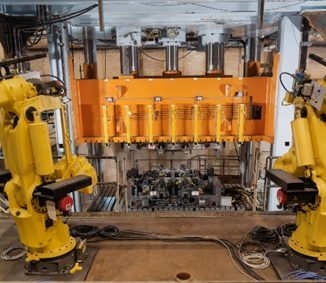
A standard press is built to a generic interface specification. Integrating a standard hydraulic press into a sophisticated automated line often requires significant custom work and that work is easier, cleaner, and less expensive when it starts at the design stage rather than the installation stage. Controlling architecture, physical envelopes, safety interlocking, and communication protocols all need to be designed with the broader system in mind from day one.
The manufacturers who will compete most effectively over the next decade are those who think of their hydraulic press not as a piece of standalone equipment, but as a fully integrated node in a connected production system. That mindset needs to be present at the specification stage.
There is a tempting assumption that as automation and connectivity become more standardized, the case for custom equipment weakens. The opposite is true.
Standardized automation infrastructure robots, PLCs, MES platforms actually raises the stakes on the machines those systems are built around. A press that does not integrate cleanly, does not communicate reliably, or does not perform consistently becomes the weak link in an otherwise optimized line. The more sophisticated the surrounding system, the more precisely the press needs to perform.
Custom-engineered presses are built to fit production environments with specific production / integration requirements. As those requirements grow more complex and more connected, the greater the value that the press, at the heart of the cell, was purposely designed rather than adapting to it.
If you are specifying a hydraulic press today, you are making a decision that will be with you for 30+ years. The automation landscape in 2040 will look vastly different from today and your press specification should account for that.
That means designing in communication interfaces even if you are not using them immediately, thinking about control system architecture with future upgrades in mind and choosing a press manufacturer, like Williams, White & Company, which understands where industry is headed.
The physics of hydraulic pressing is not going to change. But the intelligence, connectivity, and integration capability surrounding the press will continue to advance and manufacturers who build for that future today will have a significant advantage over those who do not.