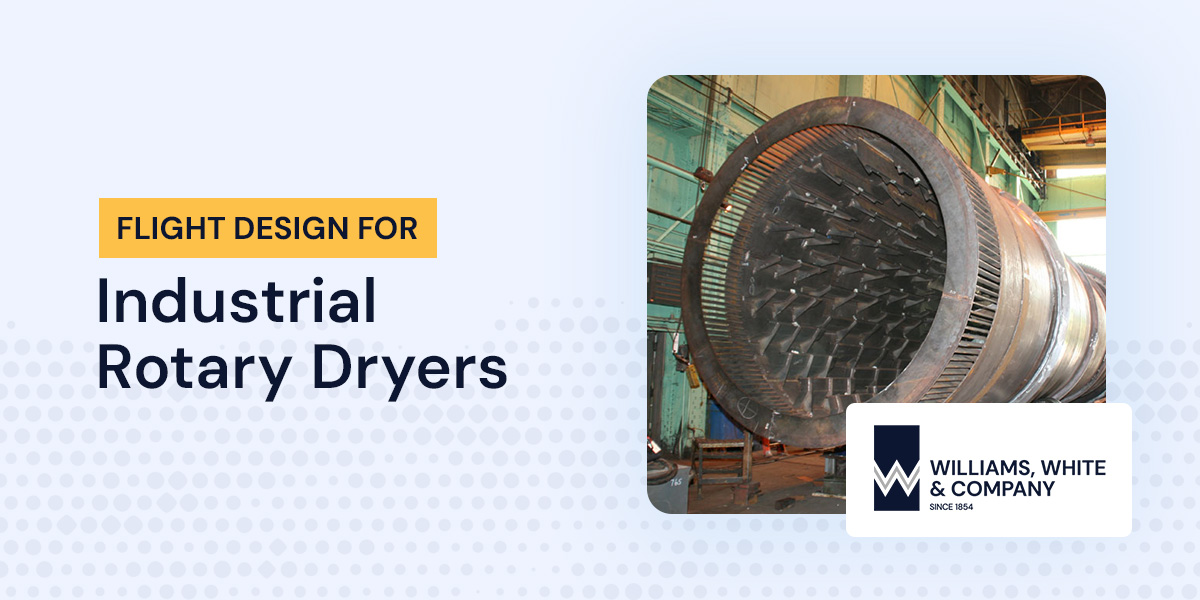
A rotary dryer's efficiency relies on its engineering, with internal flights being a crucial component. Flights, also known as lifters, create the material curtain essential for uniform drying.
This guide covers flight design selection to enable greater throughput and prevent common operational failures. Appropriate rotary dryer lifting flights enhance drying consistency, minimize operational inefficiencies and decrease downtime.
Why Your Flight Design Matters
Poor flight design creates operational challenges with direct financial impact. The consequences of incorrect flight selection are measurable and costly:
Inefficient heat transfer: Flights that do not distribute material correctly allow hot gas streams to bypass feedstock. This leads to uneven thermal exposure, extending drying times and increasing fuel consumption.
Product quality issues: Insufficient lifting action causes material clumping and inconsistent moisture removal, resulting in off-spec product.
Accelerated equipment wear: Poorly designed flights lead to uneven material distribution and loading conditions, increasing wear on dryer components.
Reduced energy efficiency: The flight system dictates material retention time within the dryer. Designs that do not control this waste energy and reduce throughput.
Effective flights increase heat transfer by continuously exposing fresh material surfaces to the drying gas stream. This creates a uniform material curtain that enhances drying consistency throughout the drum.
The flight system also impacts material retention time, influencing both drying performance and throughput. Correct flight design affects fuel consumption and overall energy efficiency in direct-fired rotary dryer systems.
Common Rotary Dryer Flight Designs
Rotary dryer flight design dictates how material is lifted, cascaded and distributed throughout the drum. No single flight design works for every material.
Dryers often employ multiple flight styles, with configurations changing from the feed end to the discharge end to account for variations in material moisture content and flow characteristics as drying progresses.
Flight arrangement is also critical — staggered configurations establish a more consistent material curtain.
Single-Bend Flights
Single-bend flights provide predictable material distribution and discharge patterns. These flights offer a balance between lifting capacity and simple maintenance.
They are typically applied to granular materials with low moisture content that flow freely and do not require aggressive agitation. Operations often select single-bend designs to prevent product damage from excessive agitation.
Saw-Tooth Flights
Saw-tooth flights promote more uniform material distribution across the gas stream. The design creates multiple discharge points along each lifter, increasing surface area exposure during cascading and enhancing heat transfer efficiency.
Saw-tooth flights are effective for moderate agitation without excessive product degradation.
Hooked and Double-Bend Flights
Hooked and double-bend flights provide greater lifting action for dense or wet materials. These designs improve showering action for products with poor flow characteristics.
They prevent material from sliding along the drum bed, a common issue with high-moisture feedstock. These flights are typically used in applications that require rigorous moisture removal.
Custom Flight Systems
Custom flight systems combine multiple flight profiles into a single dryer. Engineers design these systems using operational data and material testing, addressing specific material behavior at different stages of the drying process.
Custom configurations solve recurring issues such as product carryover, buildup or inconsistent moisture levels. These systems frequently improve throughput and drying efficiency without requiring a larger dryer.
How to Choose Rotary Kiln Flights
Selecting the right rotary dryer flight design begins with analyzing the characteristics of the material being processed. Each variable plays a specific role in determining which flight configuration will perform best:
Material properties: The angle of repose, stickiness and particle size of your feedstock determine how material will interact with different flight geometries. Free-flowing granular materials behave differently than cohesive or sticky products.
Moisture content: Initial moisture levels, target final moisture and evaporation rate all influence which flight design performs best throughout the drying process.
Operational goals: Required throughput and drum fill percentage establish the baseline parameters for flight selection. Higher throughput targets may require flight configurations that increase material exposure while maintaining adequate retention time.
Several additional considerations beyond the primary variables affect flight design selection. Each factor contributes to long-term performance and cost efficiency:
Material behavior during drying: Many materials change significantly as moisture is removed. Wet feed often requires aggressive lifting, while drier material demands gentler handling. This variations necessitate different flight profiles along the drum length in some dryers.
Gas stream distribution: The ideal flight design ensures maximum exposure to the drying gas stream. Uniform distribution yields more consistent drying results and even material exposure throughout the drum.
Maintenance requirements: Certain flight designs incur higher wear based on material abrasiveness. Long-term maintenance costs warrant consideration alongside drying performance.
Engineered Flights for Your Application
Addressing these variables requires a custom-engineered solution specific to your material and process requirements. Williams, White & Company takes a consultative approach that starts with material analysis:
Material-specific design: We analyze your material to design, model and fabricate a flight configuration tailored to your process requirements. This approach helps ensure flight performance aligns with your operational goals.
Retrofit capabilities: Retrofitting existing dryers with replacement flights or complete flight system upgrades improves efficiency and throughput without replacing the unit. Our engineering team identifies performance bottlenecks through detailed analysis.
Custom system development: Custom flight systems reduce operating costs and improve product consistency. We develop solutions that address your challenges, offering tailored configurations rather than standardized options.
In-house manufacturing: We control every step of the process, maintaining quality control and manufacturing consistency throughout the project. This integrated approach streamlines project execution and supports reliable outcomes.
When you work with Williams, White & Company, you partner with a company backed by more than 170 years of industrial manufacturing experience.
Request a Custom Dryer Consultation
The correct flight configuration significantly impacts drying efficiency, throughput and product quality. A custom-engineered flight system offers an effective means to enhance performance and long-term efficiency. This applies whether you're designing a new rotary dryer or upgrading an existing system.
Contact our engineering team to discuss your material and explore a rotary dryer solution tailored to your process requirements.