American Iron: The Legacy of Williams, White & Company
3 MIN READ
SHARE:
Troy Hamilton, Vice President of Technical Sales – Williams, White & Co.
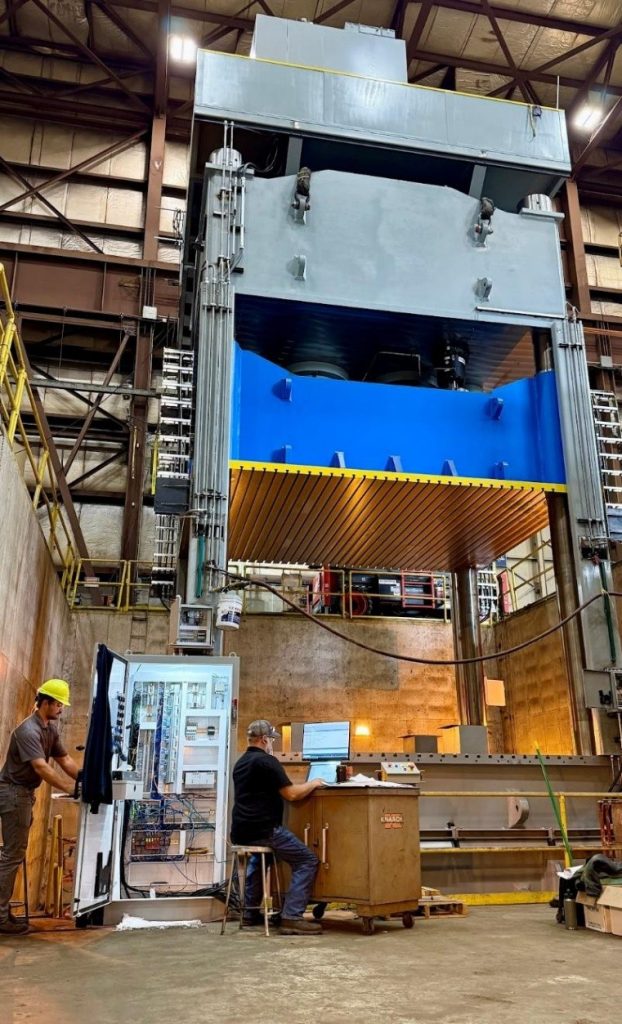
At Williams, White & Company, we don’t measure the lifespan of our machines in years — we measure them in generations. Since 1854, we have built a reputation for engineering “American Iron” that outlasts the buildings they are housed in, passed on from owner to owner as facilities trade hands.
In the world of heavy manufacturing, “disposable” is a dirty word. When you invest in a hydraulic press, you aren’t just buying a piece of machinery — you’re investing in the future of your production line for the next several decades.
The 40-to-50-Year Standard
While many modern machines are built with “planned obsolescence” in mind, our hydraulic presses are engineered for a service life of 40 to 50 years.
Industrial environments are harsh. Heat, dust, and continuous high-tonnage cycles can degrade lesser machines. We use high-strength materials and oversized components to ensure that our presses operate well within the designed safety parameters. By “over-engineering” the critical load-bearing elements, we ensure the machine can handle the rigors of a 24/7 production environment.
It is not uncommon to walk into a North American forging or molding facility and find a Williams, White press that has been running since the mid-20th century. This longevity is the result of a design philosophy that prioritizes structural integrity over short-term cost savings.
Custom Engineered Solutions
One reason our presses become the “backbone” of a facility is that they are rarely one-size-fits-all. Williams White specializes in custom engineered solutions — meaning each press is designed to solve a specific production bottleneck.
Custom Tonnage: From 500 tons to over 10,000 tons.
Specialized Applications: Our expertise spans from simple pressing into complex fields like hot and cold forging, composite molding, and plate bending.
Material Versatility: Our machines are designed to handle everything from traditional steel and aluminum to advanced aerospace composites that require precise thermal and pressure controls.
Machine Upgrades / Rebuilds
A press that lasts 50 years will eventually see technology pass it by. However, a Williams, White frame is so robust that it often outlives its original hydraulic and control systems. We recently had a customer require a press upgrade in the shipbuilding industry on the east coast that included some of the following changes:
Control System Upgrades: Replacing 30-year-old relays with modern, PC-based PLC controls using Allen-Bradley ControlLogix.
Hydraulic Retrofitting: Swapping out older Oilgear pumps for energy-efficient Rexroth HPUs.
OEM Parts & Service: Because we maintain the original drawings for nearly every machine we’ve ever built, we can provide replacement parts for presses that have been in the field for decades. Our upgrades were documented and provided to the customer for future maintenance requirements.
Predictive Maintenance and Lifetime Support
The key to a 50-year lifespan isn’t just the build, it’s the care. Our service programs are designed to be predictive rather than reactive. Through regular field inspections and component monitoring, we help our partners identify minor wear before it leads to catastrophic downtime.
An Investment in Stability
When you choose Williams, White & Company, you are partnering with a firm that has been around for over 170 years. Our 150,000-square-foot facility in Moline, Illinois, is dedicated to ensuring that the press you buy will be the manufacturing staple of your facility in 2075. In an era of shifting global supply chains and fluctuating quality, there is still something to be said for heavy-duty, American-made reliability.
If your operation demands a hydraulic press that’s built right, built to last, and backed by over 170 years of American manufacturing heritage — there’s only one place to look.Contact the Williams, White & Co. team today.