
Rotary Dryer Selection Guide
When you consider that a typical heavy-duty rotary dryer lasts decades, the importance of picking a reliable, application-matched dryer becomes …
March 27, 2026
READ MORE


Look at this thing.
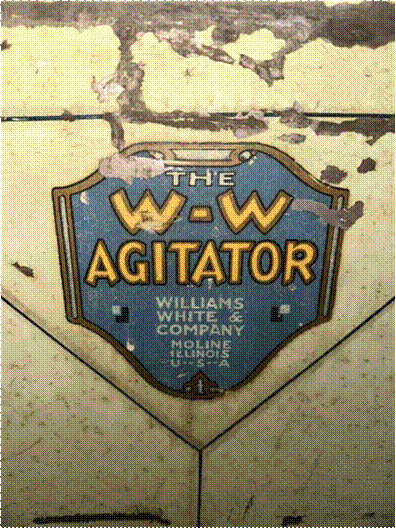
Four cast iron legs. Cream paint peeling at every seam. A galvanized tub perched on top with a hand-locking lid. A badge on the front that reads: The W-W Agitator. Williams, White & Company. Moline, Illinois, U.S.A.
This is a washing machine. And we built it.
That surprises a lot of people. Williams, White & Company has been synonymous with hydraulic presses since the mid-1800s. Heavy iron. Massive tonnage. Industrial forming equipment built to last decades on a production floor. A washing machine doesn’t exactly fit the mental image — and that’s precisely what makes it interesting.
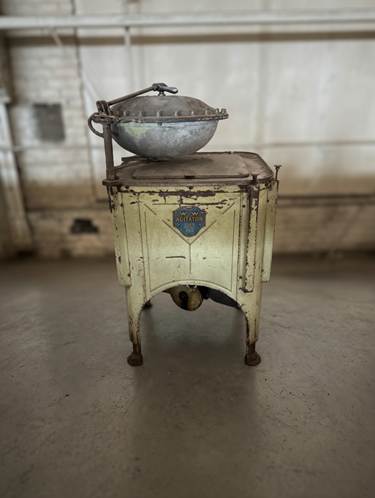
The W.W. Agitator is an early electric washing machine, believed to have been manufactured somewhere between 1910 and the 1940s. The design is straightforward by modern standards, but the execution is anything but — built with the same exacting craftsmanship Williams, White & Company brought to everything that left our shop.
The machine works in two parts. Up top, that large, galvanized basin is where the laundry goes — clothes loaded in, hot soapy water added, lid locked down. Below, inside the painted steel cabinet, sits the business end: an electric motor driving a mechanical agitator mechanism. That agitator — a rotating or oscillating paddle assembly — forces water through the fabric repeatedly, working out the dirt the same way hand-scrubbing would, just faster and without destroying your knuckles.
What stands out isn’t the concept. It’s in the execution. The riveted seams. The heavy-gauge steel stampings. The precision of the linkage arms connecting motor to mechanism. This wasn’t assembled on a consumer products line. This was built the way Williams, White & Company built everything — like it needed to last.
The honest answer is: because that’s what you do when you’ve been around long enough.
Williams, White & Company was founded in Moline, Illinois in 1854. That’s before the Civil War. Before the telephone. Before the automobile. A company that old doesn’t survive by doing one thing forever — it survives by being useful, whatever useful looks like in a given decade.
The years spanning 1910 through the 1940s were brutal for American manufacturers. Two world wars sandwiching the worst economic collapse in the nation’s history. Companies folded. Factories went dark. The ones that made it through were the ones willing to manufacture what the market needed, even if it wasn’t glamorous, even if it wasn’t their specialty.
For Williams, White & Company, that meant building agitators. It wasn’t the work we were best known for. But we built them the same way we built everything else: properly, durably, without cutting corners. The badge on that machine — still readable after a century — is proof enough of that.
“The ones that made it through were the ones willing to manufacture what the market needed — even if it wasn’t glamorous, even if it wasn’t their specialty.”
Here’s where the story gets good.
Williams, White & Company doesn’t make washing machines anymore. Or refrigerators. Or any household appliance. Today, the most recognized appliance brands in the world build their products on Williams, White & Company hydraulic presses.
The refrigerator panels. The door skins. The structural components stamped and formed from raw sheet metal. That work happens on our equipment. We went from building the appliance to building the machine that builds the appliance. It’s the kind of full-circle moment that only makes sense after 170 years.
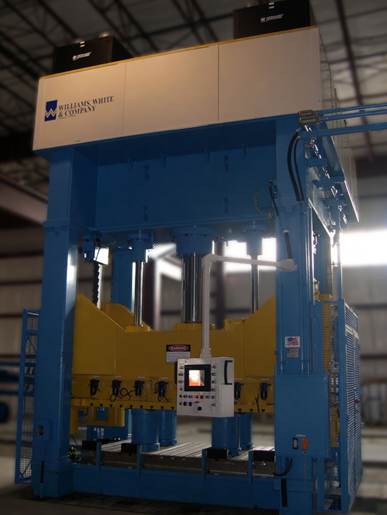
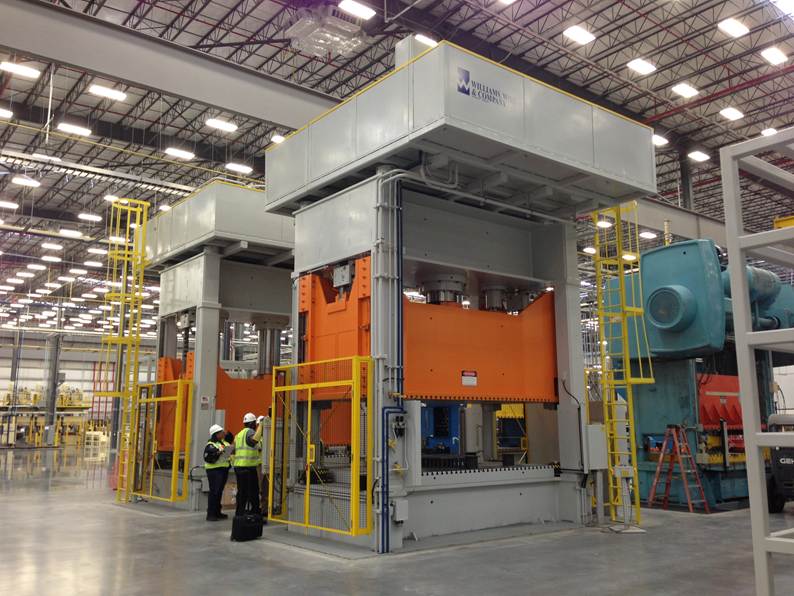
Every hydraulic press Williams, White & Company manufactures is a custom build — any tonnage, any configuration, engineered specifically for the application in front of us. From compact presses to multi-thousand-ton systems, the process is the same: we start from your requirements, not from a catalog.
That engineering flexibility is what sets our presses apart. A few of the options our customers rely on most:
■ Suppression Cylinders — When a press punches through material, the moment of breakthrough sends a violent snap-through shock through the frame — the kind that damages tooling, stresses the press structure, and shortens the life of everything it touches. Suppression cylinders are engineered to dampen and absorb that energy right at the moment of breakthrough, keeping the force controlled and the equipment protected.
■ Cushion Cylinders — Used for blankholder force during the draw stroke and part ejection at cycle’s end, cushion cylinders deliver controlled resistance that prevents wrinkling in formed parts and ensures clean, reliable part release.
■ Level Cylinders — These actively level the press slide throughout the stroke, maintaining tight parallelism and holding the close tolerances that precision forming demands.
■ Rolling Bolsters — For operations that require fast die changes, rolling bolsters let dies be staged and swapped quickly and safely — cutting changeover time and keeping production moving.
■ And much more — Custom bed and slide configurations, servo-hydraulic controls, integrated automation, and tooling interfaces built around your process. If your application needs it, we engineer it.
That W.W. Agitator has been sitting somewhere for the better part of a century. The paint is gone in patches. The steel has surface rust. But the structure is sound, the badge is intact, and you can still read every word on it.
That’s not an accident. That’s what happens when a machine shop builds something instead of a consumer products line.
Williams, White & Company is still here — still in the USA, still being built to the same standard, still engineering presses that our customers will be running twenty years from now. The products look different than they did in 1920. The commitment doesn’t.
If you need a hydraulic press that’s built to that standard, let’s talk.
