Rotary Dryer Selection Guide
When you consider that a typical heavy-duty rotary dryer lasts decades, the importance of picking a reliable, application-matched dryer becomes …
March 27, 2026
READ MORE

When you consider that a typical heavy-duty rotary dryer lasts decades, the importance of picking a reliable, application-matched dryer becomes increasingly apparent.
A rotary dryer is used to reduce the moisture content of bulk materials. These machines come in various types, making selection a challenge for many businesses. To help you select the right rotary dryer for your specific material needs, this guide covers the different types of rotary drying technologies and their ideal industry applications.
Before discussing the specific types of rotary dryers, it's crucial to review factors to consider, starting with the primary difference between direct and indirect heating. These two heating methods will ultimately determine which equipment best aligns with your ideal configuration. Often, your choice will depend largely on your material's compatibility with combustion gas contact and on product quality, emissions and safety requirements.
Direct heat application, or convection, in industrial drying occurs when hot gases flow directly over the material. This method transfers heat to the material primarily by convection, with some contribution from radiation and conduction depending on design and temperature, often enabling quicker processing times and high evaporation rates.
Direct systems can be cost-effective and thermally efficient, but actual energy performance depends on exhaust temperature, leakage air, heat recovery, and site-specific constraints. Convection is commonly used for free-flowing granular materials and some non-sticky crystals or pellets. Very sticky, viscous, paste-like feeds typically require specialized rotary designs or alternative dryer types to avoid buildup and poor material flow.
Meanwhile, indirect heat transfer, or conduction, relies on a heat source warming the material through a physical barrier. While conduction often has lower instantaneous heat-transfer rates than direct systems and may require more heat-transfer surface area, it can be gentle and controlled, helping reduce the risk of overheating heat-sensitive materials.
There is also a greatly reduced risk of flue-gas-related contamination. Combustion gases do not contact the product, though contamination risks are not literally zero. This heating method works well for heat-sensitive products, for materials that must not contact combustion gases, and for applications where isolating off-gas streams is important.
The volumetric heat transfer coefficient is a vital parameter that influences the required dryer volume, heat-transfer area and operating conditions of a rotary dryer. Just as with heating, there are also two ways air flows through the dryer — co-current and counter-current — that will depend on the unique characteristics of your product. The best choice depends on the material's heat sensitivity, target outlet moisture and allowable product temperature.
A co-current or parallel airflow system works by allowing hot gas to flow in the same direction as the material. It is suitable for heat-sensitive products due to its reduced risk of overheating the driest product near discharge and its fast surface moisture removal. However, it may be less thermally efficient in some applications.
In contrast, a counter-current airflow system moves hot gas against the material through a rotating drum, so the hottest gas contacts the driest material before exiting the dryer. This system is best for removing internal moisture and can achieve very low outlet moisture compared to many co-current systems. Counter-current airflow is also often highly efficient, but it struggles to control solids' temperature and is more likely to overheat heat-sensitive materials near the discharge if not carefully designed and controlled.
With your decision-makers in place, you can learn more about our rotary dryer offerings and determine which equipment best suits your application. Examining the specific applications of these rotary dryer types will clarify how each system handles volume removal using its own method.
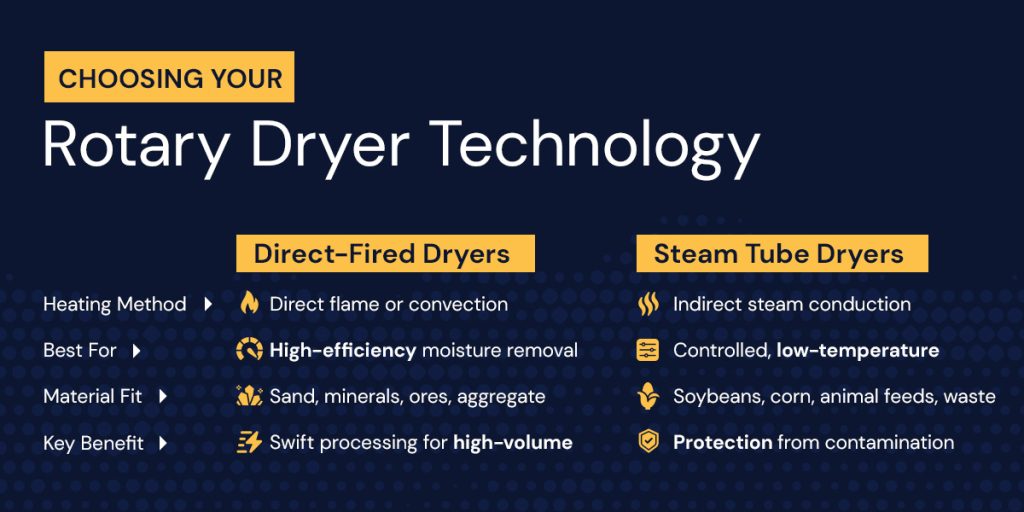
A rotary direct-fired dryer uses direct flame or convection as an efficient heat source. This equipment enables the swift and consistent removal of moisture from materials. Other benefits of our rotary direct-fired dryers include:
The following materials can be safely processed with rotary direct-fired dryers:
A rotary steam tube dryer uses hot gases as a stable heat source. Because it prioritizes energy efficiency and operational stability over direct heat, it's appropriate for materials that operate in the 250-350° Fahrenheit range. Additional benefits of using rotary steam tube dryers are:
Regarding applicable material types, rotary steam tube dryers work efficiently with the following:
The thermal process continues with effective material cooling. Knowing the difference between rotary air coolers and water-tube coolers is crucial to ensure your products do not condensate or degrade during storage:
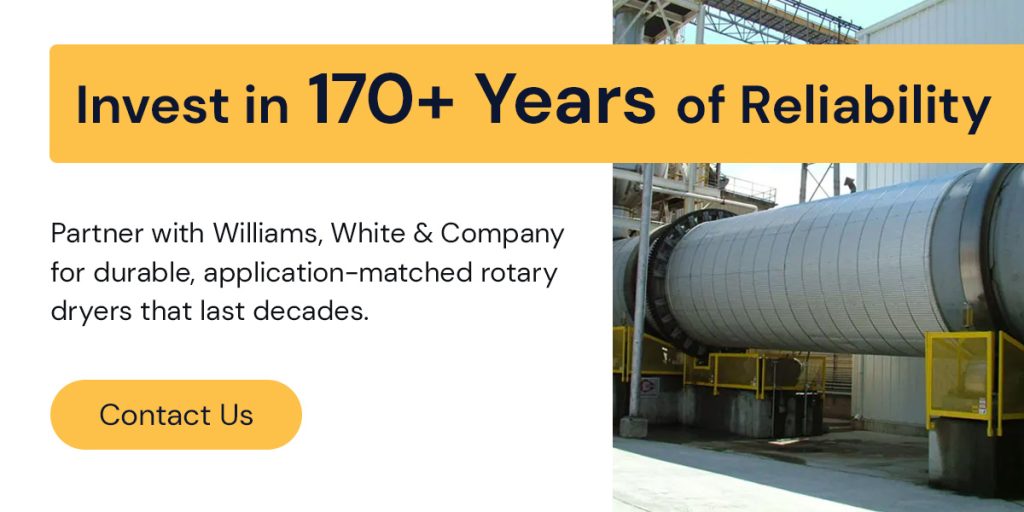
At Williams, White & Company, we prioritize quality and longevity. With over 170 years of delivering top hydraulic presses and rotary industrial dryers for different industries, we take pride in helping our customers reach their business goals without compromise.
By partnering with Davenport Dryer for our equipment, we are able to provide consistent results and machinery to clients across industries worldwide. With Davenport Dryer's engineering and manufacturing, we ensure that our rotary dryers stay in service for 40 to 50 years with our proper support and maintenance. We also provide exceptional customer support. If you need further clarity on how rotary dryers are used in different industries, our support team can guide you to the right solution.
Are you ready to commit to a reliable long-term investment? Contact Williams, White & Company today and explore partnership options for your products and performance goals.