
How to Choose a Hydraulic Press
Purchasing a hydraulic press is a crucial decision that impacts your product quality and long-term profitability. You need equipment that …
March 27, 2026
READ MORE

Purchasing a hydraulic press is a crucial decision that impacts your product quality and long-term profitability. You need equipment that integrates smoothly into your production process and runs reliably for as long as possible. Whether you work in automotive, manufacturing, metalworking or construction, this hydraulic press selection guide explores the characteristics to look for when choosing the best machine for your operation.
In industrial manufacturing, “off-the-shelf” presses usually fall short of real-world requirements. While it can be tempting to choose a catalog machine because it is convenient and immediately available, these machines rarely deliver the performance, efficiency and longevity needed for specialized production processes.
Working with a partner who designs custom presses ensures you receive a solution tailored to your hydraulic press requirements—enhancing performance and optimizing your day-to-day operations.
The difference between buying equipment and engineering a solution comes down to customization and expert manufacturing. A custom machine is a long‑term, production‑ready solution that meets stringent industrial specifications. Tailoring every element — from tonnage to bed size — to match your material properties, cycle times and precision requirements results in a press that fits seamlessly into your production line and operates efficiently enough to strengthen your bottom line.
Industrial hydraulic presses are a significant capital investment, usually operating reliably for 40 to 50 years. Due to their extended lifespan, it's crucial to work with a company that values long-term quality and support. Choose a partner that offers lifetime parts support, service and field inspection, so your hydraulic press can be a high-performing asset throughout all decades of operation.
While a custom hydraulic press is more expensive up-front, the value of engineering expertise throughout the equipment's entire life cycle yields a high return on investment with decades of quality and reliability.
Choosing the best industrial hydraulic press starts with defining your application needs. Evaluate your material properties, precision needs and production volume to get a hydraulic press that performs its best and yields the highest return on investment.
Different materials can produce unique properties under pressure and need specific configurations. Are you forming tough alloys, delicate composites or intricate plastics? You must understand the material's yield strength, ductility and how it behaves when met with forming forces. For instance, deep drawing applications need different press characteristics than those used for coining or forging.
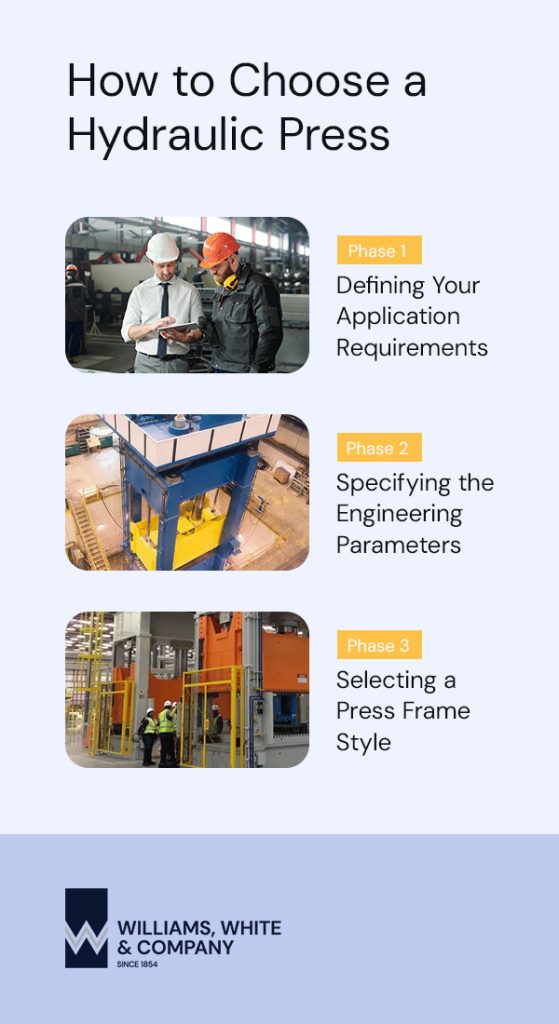
You'll need to choose a reliable partner to engineer your press, ensuring that its ram speed, control and other capabilities match your material's flow characteristics to prevent defects and optimize part quality.
Consider the precision and tolerance needs for your specific finished product. Applications that need tight tolerances, like those in the aerospace or medical industries, require presses with excellent frame rigidity, advanced control systems and precise ram guiding.
An imprecise press can lead to higher scrap rates and costly rework. It may also fail to meet critical specifications. That's why partnering with experts is crucial for a hydraulic press that delivers repeatable results and exceeds accuracy standards.
You can also choose your press based on your desired production output, as measured in parts per minute or hour. High-volume applications demand faster cycle times, which means using a press designed for rapid advance, pressing and return speeds. In contrast, lower volume, high-force applications require a sturdy frame construction and sustained tonnage more than sheer speed.
After assessing your projected production volume and cycle time goals, you can choose from industrial hydraulic press types that meet those demands without sacrificing quality or long-term reliability. Your press should be able to prevent bottlenecks and ultimately increase uptime.
Once you've defined your application requirements, it's time to translate your operational needs into concrete technical specifications.
Tonnage is the maximum force a press can exert. To determine this fundamental parameter, calculate the peak force required for your specific material and process, then choose a press capable of handling everyday operations and overloads without stressing the machine.
Factors like material thickness, hardness, shape and desired deformation will influence this calculation. The goal is to accurately assess this so you can prevent under-tonnage, premature wear and inefficient processing. It will also help you avoid the unnecessary capital expense of over-tonnage.
You'll need to consider the press's physical workspace and whether it suits your parts and tooling.
Your hydraulic press should be able to achieve the appropriate speeds and control for your materials and operation. For instance, consider the approach speed, which gets the ram to the workpiece quickly, and the pressing speed, or the rate at which the work stroke applies force. The pressing speed often needs to be slower and more precisely controlled. Lastly, return speed retracts the ram and minimizes cycle time.
You can achieve more intricate results, improve efficiency and increase uptime with the correct speed and control systems.
Real-world applications can bring challenges such as off-center loading. Know how each press can handle these conditions. Too much deflection can lead to part inaccuracies or even damage the press frame. That's why you should always work with engineering experts who can design a press frame that minimizes deflection and distributes force uniformly, even under off-center loading conditions.
The hydraulic press's frame style influences its rigidity, accessibility and suitability for different applications. Be aware of these different industrial hydraulic press types.
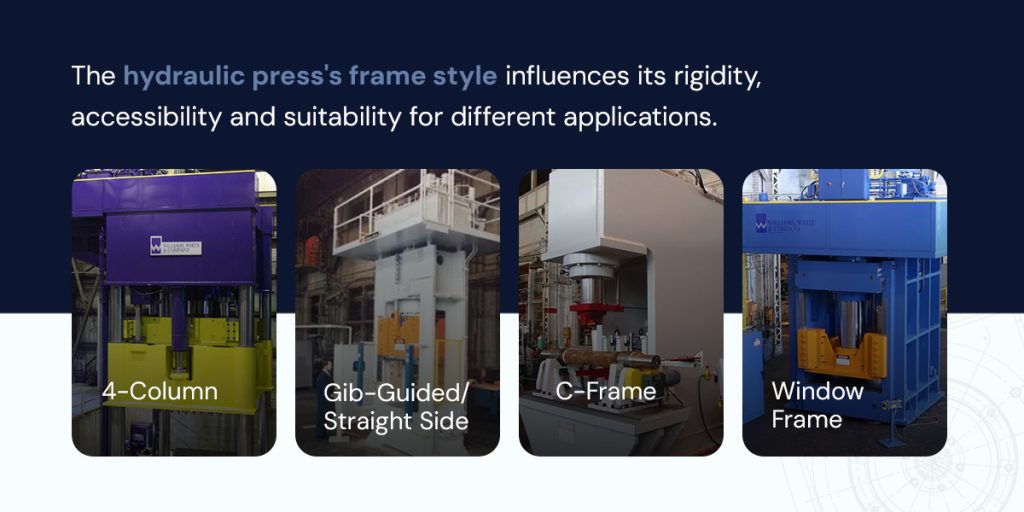
The four-column press is one of the most common, versatile frame styles for hydraulic presses. These presses feature platens guided by four columns. Access from all four sides is critical for applications like automated material handling, robotic integration and manual loading of bulky or irregularly shaped workpieces.
Four-column hydraulic presses have an open design, which simplifies die changes and maintenance.
Gib-guided or straight-side presses are usually the preferred choice for applications requiring extreme accuracy and minimal deflection. These feature a fully enclosed frame structure, often with a joined crown, uprights and bed. They also have a moving ram guided by precision gibs.
Their build makes these presses more resistant to off-center loading. They also deliver more precise platen parallelism, which is crucial for applications needing tight tolerances. Their rigid design allows consistent part quality and can extend tooling life.
C-frame presses, also known as gap frames, feature a C-shaped design that provides access to the die area from three sides. The design is excellent for applications that use smaller parts or need easy feeding and removal of workpieces, especially when materials need to pass through the press from side to side.
While they can offer less resistance to deflection than other presses under full tonnage, a well-engineered C-frame press can still deliver reliable performance when assembling, straightening, bending and light forming materials. Their smaller footprint also makes them ideal for facilities with limited space.
Window-frame presses are often a good choice for demanding applications that need stiffness and minimal deflection. They have a single, solid-piece frame or completely enclosed uprights that give them an extremely rigid structure. They're excellent for high-tonnage forming, forging or intricate part production where any deviation could compromise the product's integrity.
Safety is crucial when operating industrial hydraulic presses. Following strict standards will protect personnel and equipment while keeping your operations running without interruption.
The primary safety standards for hydraulic presses are ANSI B11.2 and Occupational Safety and Health Administration regulations.
Advanced mechanisms can reduce risks and protect personnel throughout the equipment's life cycle. Invest in a hydraulic press with integrated safety features like these.
An experienced manufacturer can offer the engineering support you need to keep your investment operating at peak performance for decades. Williams, White & Company proudly carries the distinction of being North America’s premier hydraulic press and industrial dryer manufacturer.
Williams, White & Company takes a customization-first approach. We use our engineering expertise at all points, first gaining an understanding of your application. Our integrated engineering and manufacturing capabilities let us tailor hydraulic presses that precisely fit your operational needs, maximizing productivity and return on investment.
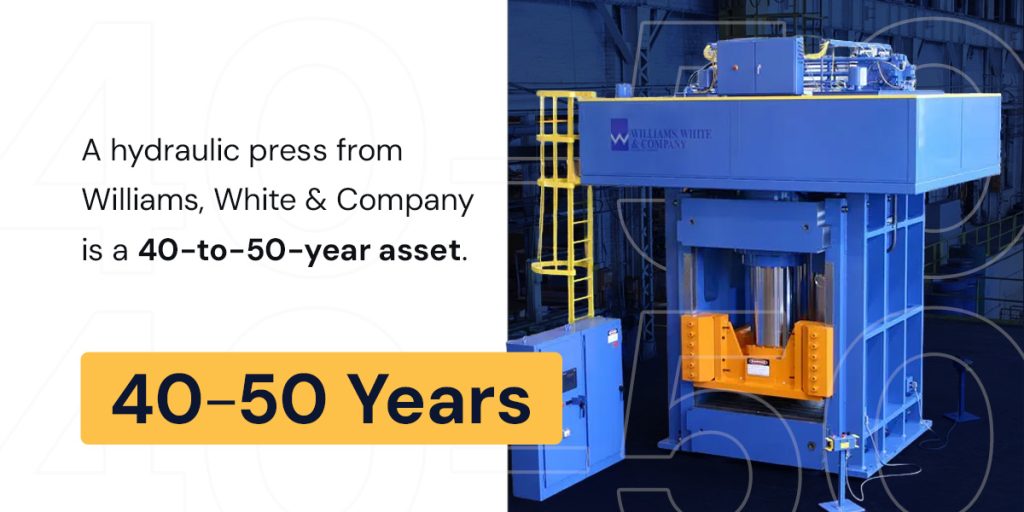
A hydraulic press from Williams, White & Company is a 40-to-50-year asset. To prolong this generous lifespan and ensure lasting value, we offer lifetime support that includes readily available parts, expert service and field inspection to address issues as quickly as possible.
Beyond maintenance, our retrofitting capabilities let us upgrade and modernize existing presses, extending their operational life and letting you incorporate new technologies for your growing production demands.
With our firm commitment to partnership and comprehensive support, we are a top supplier choice for many companies operating presses in North America. You can be confident that your production legacy is secure with us.
Williams, White & Company builds safety features directly into your hydraulic press's core design. We make technologies for your exact application, protecting personnel without impeding efficiency.
We engineer presses that meet and often exceed industry safety benchmarks so you can be confident in your operations. Have confidence that your hydraulic press is compliant from Day 1, helping you reduce the risks of accidents, penalties and downtime.
Choosing a hydraulic press is a decision that shapes your production capabilities for decades. When you work with Williams, White & Company, you gain more than a high-caliber machine. You secure a partnership founded on 170 years of engineering excellence. We design our American-made presses, backed by integrated engineering and manufacturing, to deliver reliable performance, safety and long-term value.
Invest in a custom-engineered solution that optimizes your process and keeps your operations thriving. Contact us today to learn more about our custom hydraulic press solutions and how we can transform your manufacturing future.